GERMANY23–24 OCTOBER 2026
AEC Strategic DialogueBerlin
12–15participants, including
2–3 emerging leaders
2–3 emerging leaders
A trusted, closed-door setting for examining complex Asia–Europe questions in depth.
Across perspectives, places and time.
Asia-Europe Consortium (AEC) is an independent, non-profit governance platform with hubs in Berlin and Singapore, creating a civic infrastructure for better understanding and judgment across systems.
AEC is an independent, non-profit governance platform with hubs in Berlin and Singapore.
It brings together public sector leaders, business executives, technologists, investors, academics, and emerging leaders for candid, practice-informed exchange across institutional and cultural boundaries.
We strengthen society’s capacity for informed judgment and responsible cooperation.
Our dialogues identify the questions that matter, develop and test judgments through different experiences and perspectives, and carry both forward over time — strengthening understanding, relationships and the basis for practical cooperation between Asia and Europe.
How AEC works, why it exists, and what makes its approach different.
AEC does not seek consensus for its own sake. In a rapidly changing world, it is often more important to understand what has genuinely changed, what has not, and which assumptions need to be reconsidered.
AEC starts with questions and hypotheses, bringing together people from different systems and sectors to test them against real-world experience. The aim is to develop clearer judgment, better questions and new perspectives that participants can take back into their organisations and communities.
AEC does not measure its success primarily through communiqués, joint declarations or lengthy conference reports.
The most valuable outcomes are often new questions, sharper judgments and perspectives that participants can take back and apply quickly in their own organisations.
What begins in the room should continue beyond it — through decisions, experiments, cooperation and further reflection. The value of a dialogue lies not only in what is said, but in what it enables afterwards.
Different societies, industries and institutions often experience the same global developments in very different ways. Reaching agreement too quickly can hide precisely the differences that need to be understood.
AEC therefore asks different questions: Where are we seeing the same changes? Where are our experiences different? Which assumptions still hold? Which no longer do?
Understanding those differences can create a stronger basis for informed judgment and responsible cooperation than consensus alone.
AEC exists to serve a wider public purpose rather than to maximise the commercial value of events.
Better judgment should not remain inside the dialogue room. Participants take ideas, questions and perspectives back into businesses, public institutions, universities and wider society — where their decisions may affect employees, customers, communities and citizens.
AEC therefore sees dialogue as a way to strengthen the capacity of institutions and individuals to understand change and act more responsibly within it.
No. AEC does not sell tickets or participation rights.
Invited participants do not pay a participation fee. They generally cover their own travel and accommodation.
This model is deliberate. People should be in the room because of the experience, judgment and perspectives they can contribute — not because they or their organisations purchased access.
It allows the focus to return to what matters most: the quality of the dialogue itself.
AEC is not built around stages, keynote speeches or visibility.
We begin with questions and hypotheses rather than a speaker list. Participants are not expected to defend institutional positions, lobby for particular outcomes or negotiate a common statement.
The emphasis is on creating the right room, bringing together the right people and asking the right questions — so that different forms of experience can genuinely challenge and inform one another.
The objective is not simply a successful event, but better judgment that can continue beyond the room.
Emerging leaders are not placed in a separate “youth programme”, nor are they included simply to demonstrate generational diversity.
They take part in the same conversations because many of the technological, economic and societal changes being discussed will shape their lives and responsibilities for decades to come.
They also bring perspectives formed by new industries, technologies, working environments and social realities — and may ask questions that more established leaders would not.
AEC believes that different generations should participate in shaping judgment together, rather than one generation defining the future for another.
Language is more than a translation issue. It influences how people structure ideas, express uncertainty, interpret risk and communicate disagreement.
A meaningful Asia-Europe dialogue cannot simply bring people from different countries into a room and expect everyone to think and communicate in exactly the same way.
AEC therefore aims to create an increasingly multilingual environment in which participants can express complex ideas more precisely, while reducing unnecessary barriers created by language, cultural conventions or styles of communication.
Cross-cultural dialogue should involve more than different nationalities speaking in the same way.
AEC does not invent an entirely new set of questions for every event.
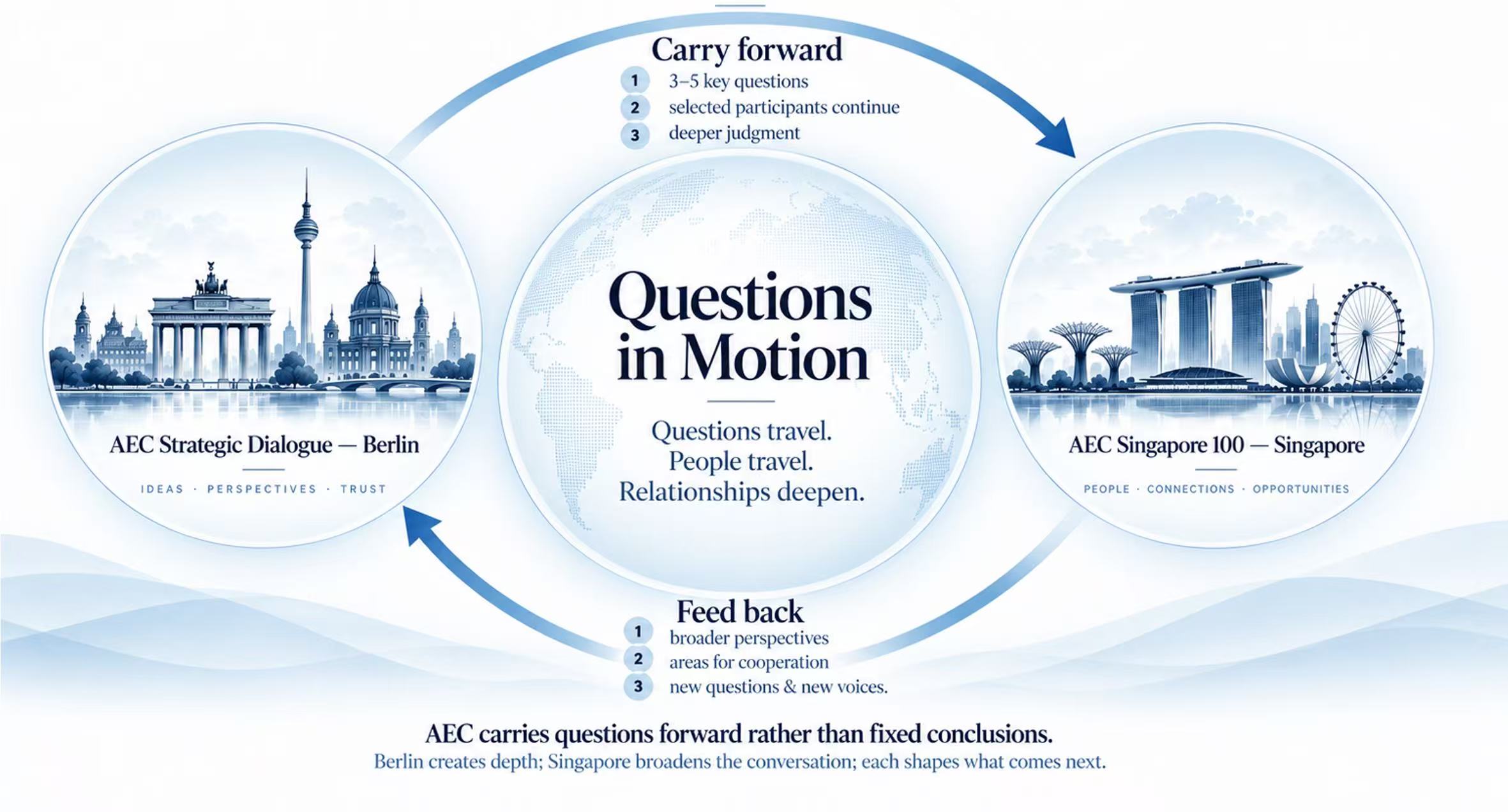
Questions, hypotheses and unresolved issues emerging in Berlin can travel to Singapore. New perspectives developed in Singapore can return to the next Berlin dialogue. Relationships between participants can deepen through the same process.
In this way, each dialogue becomes part of a continuing cycle rather than an isolated event.
People move. Questions move. Relationships develop over time.
This is what we mean by Questions in Motion.
The challenges shaping society cross sectors, systems and generations. So should the dialogue that shapes our response.
Not every important conversation belongs on a stage.
A trusted, closed-door setting for examining complex Asia–Europe questions in depth.
A broader meeting point for Asia and Europe across sectors and generations.
A first circle of people, questions and relationships begins in Berlin.
We strengthen society’s capacity for informed judgment and responsible cooperation.
Our dialogues identify the questions that matter, develop and test judgments through different experiences and perspectives, and carry both forward over time — strengthening understanding, relationships and the basis for practical cooperation between Asia and Europe.
A trusted space for candid exchange and honest reflection, without pressure to defend institutional positions.
Carefully selected people with experience, judgment and public spirit across sectors, systems, generations and cultures.
Insights and relationships carry forward across cycles, deepening understanding and enabling practical cooperation.
A closed-door dialogue in Berlin bringing together a small group of leaders and practitioners across sectors, systems and generations.
Agenda will be posted soon.
Participation is by invitation and in a personal capacity.
AEC Singapore 100 brings together a wider community of leaders, practitioners and emerging voices from Asia and Europe for dialogue, exchange and long-term relationship building.
Programme will be posted soon.
Participants will be announced progressively.
A year-round series of smaller, focused dialogues.
AEC begins with people and questions.
We place particular value on people who bring experience, judgment and a sense of public spirit — people willing to contribute beyond their immediate institutional or commercial interests.
The questions are also not designed around commercial agendas or short-term event themes. They begin with issues that matter more broadly to societies, institutions and citizens: what is changing, what is not, which assumptions still hold, and where better judgment is needed.
The mechanism is designed to create continuity between Berlin and Singapore. People, questions and relationships should move between the two hubs. Questions emerging in Berlin can continue in Singapore, while new perspectives from Singapore can return to Berlin.
This means AEC does not simply create a completely new theme for every annual event. Each dialogue builds on what came before. Questions evolve, people reconnect, and relationships deepen over time.
The result is a continuing dialogue cycle rather than a series of isolated conferences.
People move. Questions evolve. Relationships deepen.
“We have many conferences,
but too little genuine dialogue.”
Global Dialogue grew out of a long-term observation. Technology, artificial intelligence, capital and geopolitics are reshaping our societies and industries at extraordinary speed. Many of the challenges we face can no longer be addressed by a single country, company or sector alone.
Asia and Europe have never been more interconnected, yet meaningful mutual understanding between the two regions often remains limited. We have many conferences, but too little genuine dialogue. We have many opinions, but too few opportunities to understand how people shaped by different systems actually think, decide and act.
This led me to a simple conviction: bringing the right people with genuinely different perspectives into the same room is itself a form of value creation. That is the idea behind Global Dialogue.
We bring together entrepreneurs, industry leaders, investors, policymakers, scientists, civil-society voices and emerging leaders across Asia and Europe — not to manufacture consensus, but to create the conditions for better understanding and better judgment. We believe that a better question, a tested assumption or a better-informed judgment can itself be a meaningful outcome of dialogue.
Global Dialogue is also designed around continuity. Important questions should not disappear when an event ends, only to be replaced by a new theme the following year. Through our Questions in Motion mechanism, questions and judgments emerging in Berlin move to Singapore, where they are challenged by a broader range of regional, sectoral and generational perspectives, before feeding back into the next cycle of dialogue in Berlin.
Questions travel. People travel. Relationships deepen.
Over time, I also became conscious of whose voices are too easily lost in international dialogue.
One group is the next generation. Too often, emerging leaders are invited to observe established decision-makers rather than engage with them. At Global Dialogue, emerging leaders have a real place at the table. They participate fully in the discussion, contribute their own experience and challenge assumptions across generations.
Another barrier is language. International dialogue is still largely conducted in English, yet fluency in English should never become a proxy for the quality of someone’s thinking. I have met people whose experience is exceptional and whose thinking is deeply insightful, but who are less comfortable expressing complex ideas in formal conference English.
We want technology to help reduce that barrier. In Singapore in particular, Global Dialogue will use intelligent multilingual formats that allow participants, where appropriate, to contribute in the language in which they can think most clearly and express themselves most precisely. Important voices should not be lost because of language.
The same thinking shapes Global Dialogue’s independence. We are not a membership association and we do not sell access. Participation is by invitation and free of charge; participants generally cover their own travel and accommodation. Participants join in their personal capacity, rather than as mandated representatives expected to defend an institutional position. Financial support cannot purchase a seat or determine the agenda, and we apply the same care to the partners and supporters with whom we work. We want to preserve a space shaped by public spirit, intellectual independence and the quality of contribution — not commercial access.
This is why Global Dialogue is anchored in two complementary cities.
Berlin provides depth: small, closed-door conversations built around trust and candour. Singapore provides reach: a wider, more multilingual meeting point for people across Asia and Europe.
Together, they form one long-term dialogue mechanism connecting different systems, sectors, generations and voices.
Global Dialogue is still at the beginning. With the support of ESMT Berlin, we are building this platform step by step. We do not aim to be the largest forum. We aim to be a trusted one — a place where the right people can ask better questions, test their judgments against different realities and build relationships that continue beyond the room.
The quality of a conversation starts with the conditions around it.
AEC maintains full independence over its agenda, participation and dialogue format. The Co-Chairs hold final responsibility for all three, ensuring that sponsors, partners or supporting institutions cannot purchase seats, determine participation or shape the substance of the dialogue.
AEC is built for people who are willing to contribute beyond their own immediate interests and bring a genuine sense of responsibility for the wider public good.
Participation is by invitation. Seats are not sold, and financial support does not create a right to participate, speak, nominate participants or influence the agenda.
Participants are invited for the experience and perspectives they bring from the systems, sectors and societies they are part of. They join the dialogue as individuals, not as mandated representatives of their organisations. Their affiliations provide context for their experience — not instructions for what they should say.
Participants generally cover their own travel and accommodation, reflecting both AEC’s independence and a shared commitment to the dialogue.
AEC does not seek negotiated consensus, institutional positions or formal communiqués. We seek to understand different perspectives, identify where cooperation remains possible, and explore how it can work in practice.
Titles matter less than the quality of judgment, experience and contribution a person brings to the room.
AEC starts from real-world experience and focuses on dialogue that leads to clearer judgments, better questions, practical next steps and meaningful follow-up.
AEC is built around relationships that deepen over time, rather than one-off encounters or isolated events.
People bring different experiences, judgment and expertise to the room.
Participation is curated, not purchased.
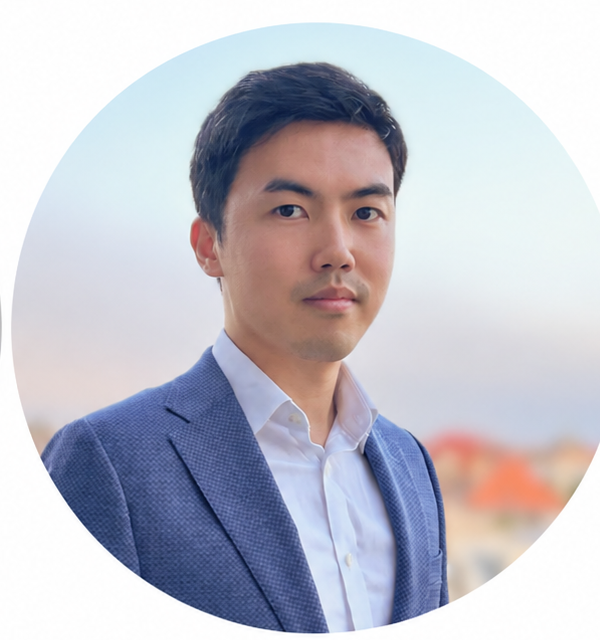
Based in Berlin, Jiaqi Weng works at the intersection of technology, entrepreneurship and international dialogue. His experience spans digital transformation, cross-sector initiatives and building connections between Europe and Asia. He brings a technology and institutional perspective to AEC, with a particular focus on how leaders navigate change, challenge assumptions and develop better judgment across different systems and cultures.
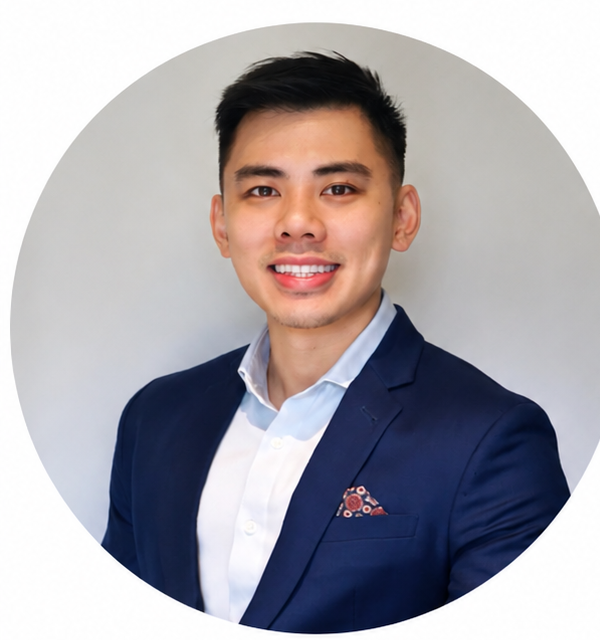
Based in Singapore, Daniel Lee brings more than 15 years of experience across the global healthcare and life sciences sector. Having held regional and global leadership roles with Pfizer, Sanofi, Bayer, Bio-Rad and Menarini, his work spans healthcare innovation, market access and commercial strategy across Europe and Asia. He contributes a healthcare and industry perspective to AEC’s mission of strengthening dialogue between Asia and Europe.
All Senior Advisors participate in their personal capacity.
Will be updated soon.
Will be updated soon.
Alongside its own dialogues, AEC actively engages with selected international forums and cross-sector initiatives. These exchanges allow us to listen to perspectives beyond our own platform, contribute to wider conversations, and remain connected to developments shaping cooperation between Asia and Europe.
AEC Founder was invited to participate in Berlin Global Dialogue 2026. Under the theme “Advancing Alliances for the New Era”.
AEC Founder participated in the dialogue with an official Shanghai municipal delegation, alongside representatives from German institutions and business.
Global Dialogue brings together people with experience, responsibility and a willingness to contribute beyond their immediate institutional or commercial interests.
Participation is by invitation and free of charge. We do not sell access or offer paid membership.